Solar Works Pakistan

Battery safety

LiFePO₄ Battery Safety: A Guide to Safer Hybrid Solar Systems

Short answer

LiFePO₄ (lithium iron phosphate, or LFP) is widely regarded as one of the more thermally stable lithium-ion chemistries for home solar storage, which is why Solar Works Pakistan installs it. Chemistry alone is not the whole answer: day-to-day safety also depends on product quality, an approved battery–inverter match, the battery management system and a professional installation.

Questions this page answers

  • Are LiFePO₄ (LFP) batteries safe for a home solar system?
  • What is inside a LiFePO₄ battery?
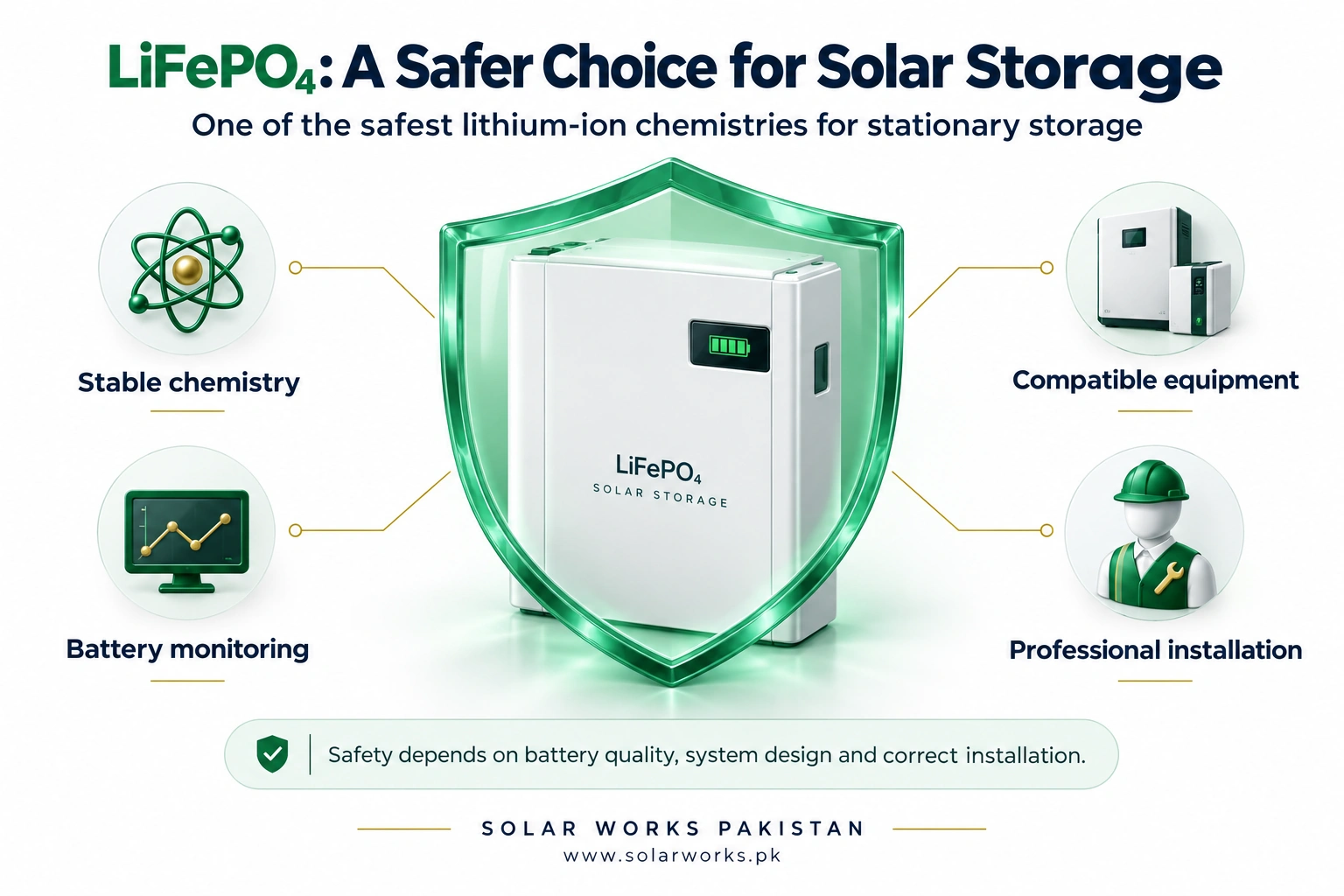
Infographic: LiFePO4 a safer choice for solar storage, with a battery inside a shield surrounded by stable chemistry, battery monitoring, compatible equipment and professional installation
Four things decide how safely a LiFePO₄ battery runs: the chemistry, the monitoring inside it, the equipment it is paired with and the installation. View full infographic ↗

Inside a LiFePO₄ Battery

A solar battery is not a single block of stored energy. It is an assembly: a set of LFP cells, an electronic controller that watches them, sensors that report temperature, and an enclosure that holds everything in place and keeps it protected.

The cells are where energy is actually stored. The controller is the battery management system, or BMS — the circuit board that keeps the pack inside the operating limits its manufacturer designed. Temperature sensors feed it readings from inside the pack, and the enclosure shields the cells and wiring from dust, moisture and accidental contact. Layouts and component choices differ from one model to another, so the exact arrangement in your battery will follow its own manual.
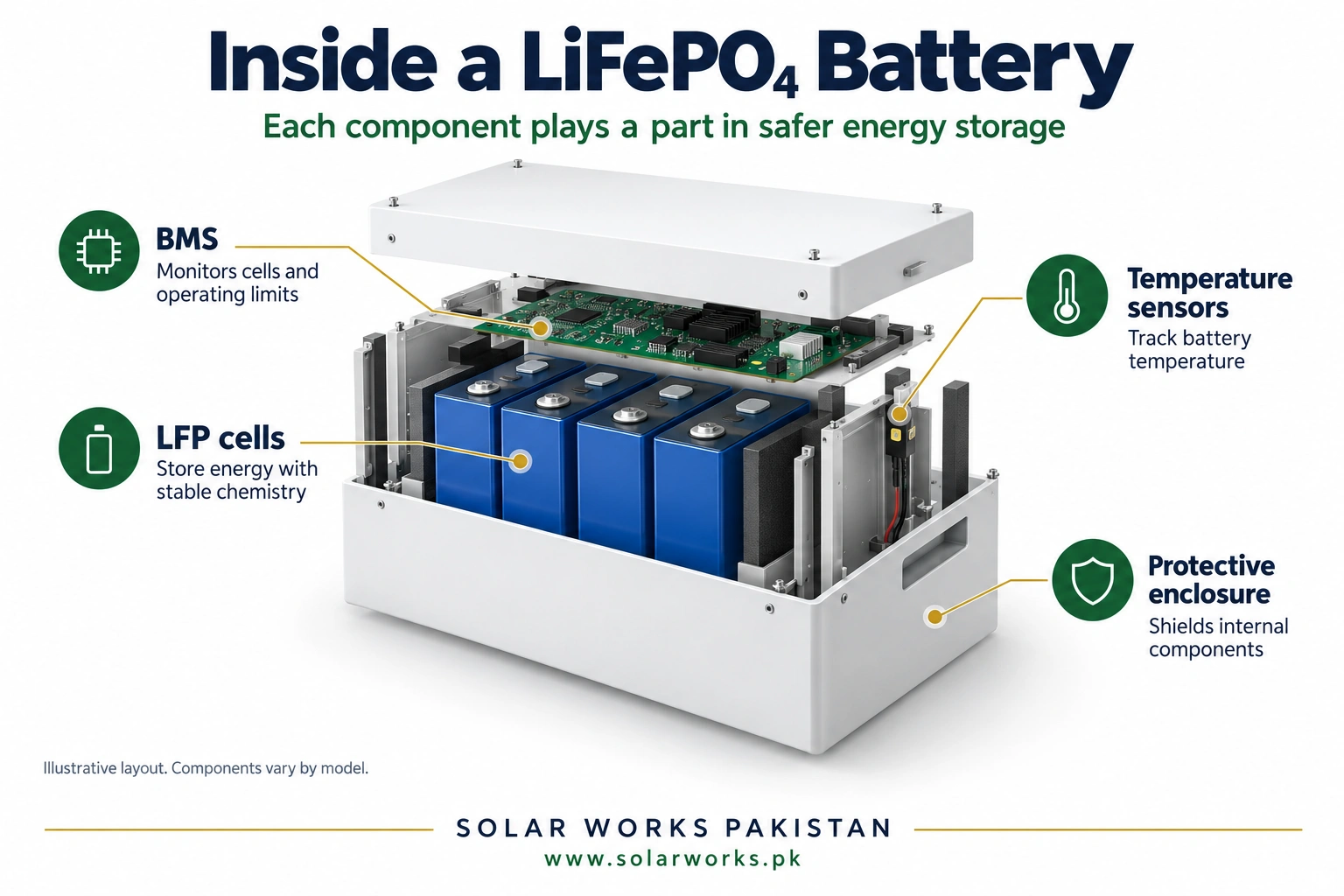
Cutaway infographic of a LiFePO4 battery showing the BMS circuit board, prismatic LFP cells, a temperature sensor and the protective steel enclosure
An illustrative cutaway — cell format, sensor placement and enclosure design vary by model. View full infographic ↗

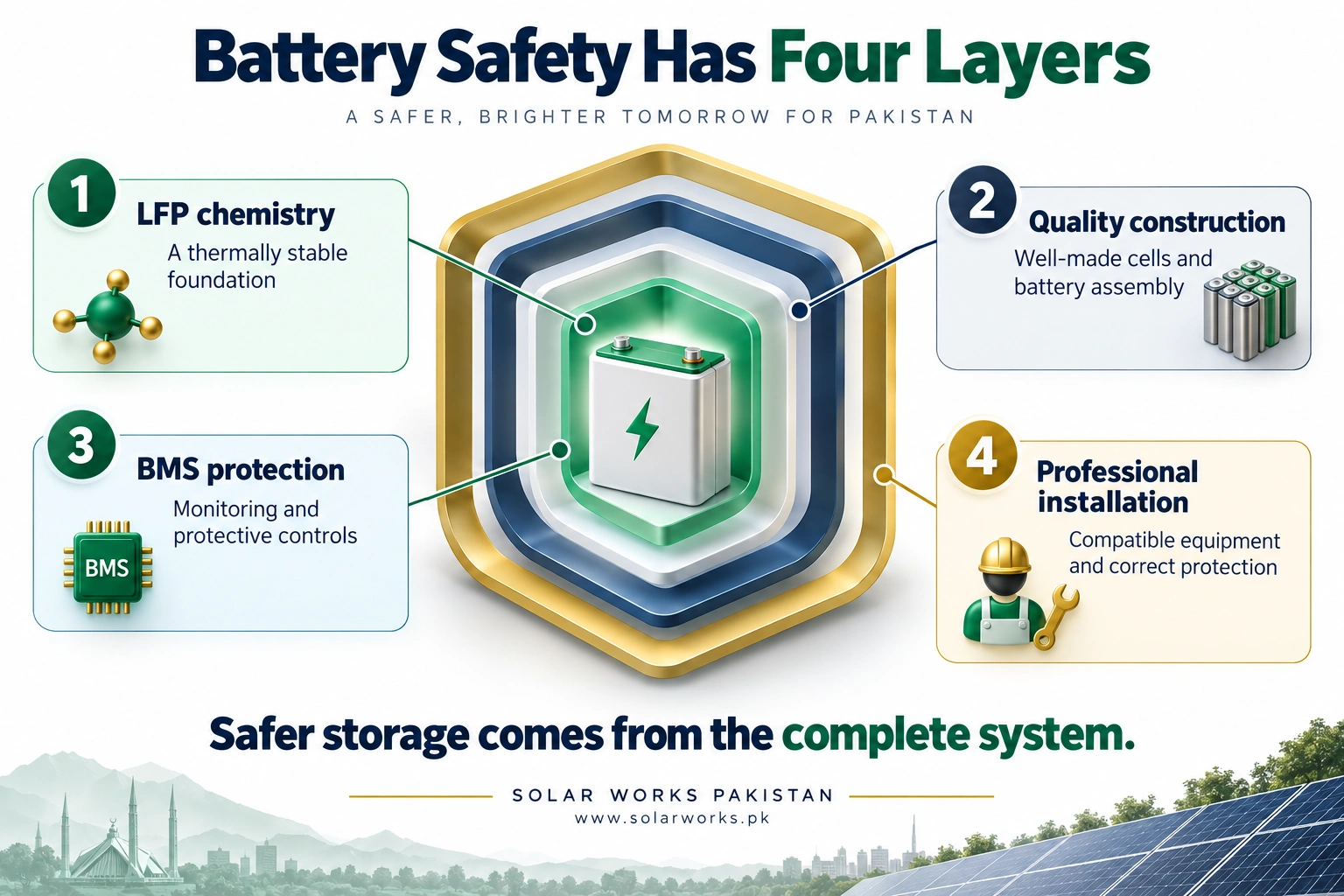
Battery Safety Has Four Layers

It helps to think of safety as four layers that build on each other. Remove one and the others have to work harder — which is where most avoidable problems begin.

Infographic: battery safety has four layers - LFP chemistry, quality construction, BMS protection and professional installation - shown as nested shields around a battery
Safer storage comes from the complete system, not from the chemistry alone. View full infographic ↗
Layer one

Chemistry

LFP is more thermally stable than several other lithium-ion chemistries used in consumer electronics and electric vehicles. That stability is a real advantage for a battery that sits on a wall for years — but no battery is fireproof, explosion-proof or free of risk, and none should be described that way.

Layer two

Construction quality

Cell grade, welding and busbar quality, internal fusing, terminal design and enclosure build all vary between manufacturers. Ask for the product documentation and the test certificates the manufacturer publishes for that exact model, and check that the unit you receive matches them.

Layer three

BMS protection

The BMS watches the pack and acts when a limit is approached — by reducing charge or discharge, or by disconnecting. What it monitors and how it responds depends on the model, so the manufacturer's specification is the only reliable guide.

Layer four

Professional installation

Mounting, cable sizing, circuit protection, clearances and commissioning are all decided on site. This is the layer a customer has most control over when choosing who does the work.

What Does the BMS Do?

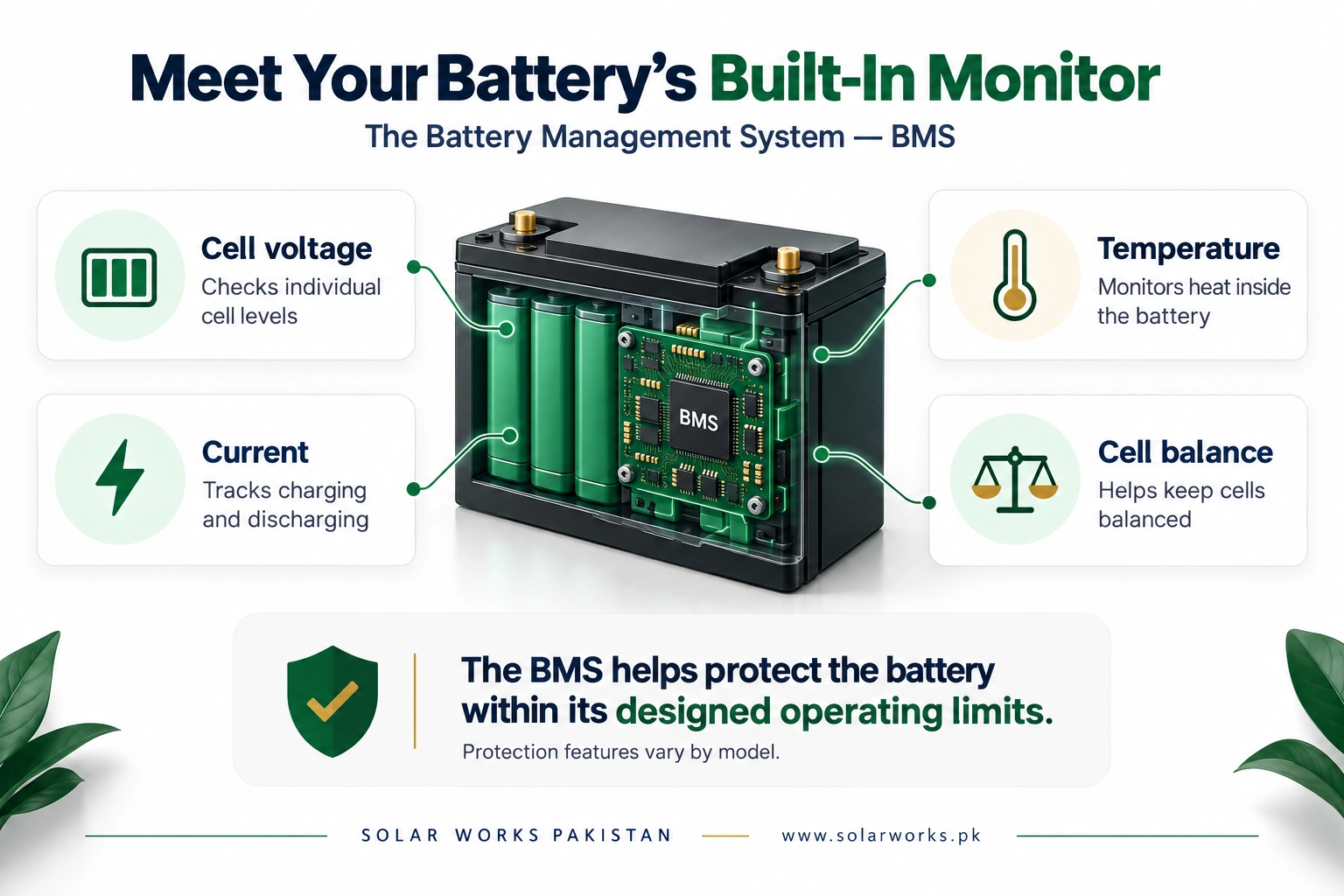
The battery management system is the battery's built-in supervisor. It watches four things continuously.

Cell voltage — not just the pack total, but individual cells, because one cell drifting out of range is a problem the pack average would hide. Temperature — readings from inside the pack, used to limit or stop charging when the battery is too hot or too cold. Current — how hard the battery is being charged and discharged, against the limits set for that model. Cell balance — small corrections that keep cells at similar states of charge, so the pack works as one.

When a reading approaches a limit, the BMS responds — typically by reducing the allowed current, raising an alarm, or disconnecting the battery. Protection features, thresholds and alarm behaviour vary by model, so treat the manual for your battery as the authority, not a general description like this one.

Infographic: the battery management system monitors cell voltage, temperature, current and cell balance inside a lithium battery
What the BMS watches inside the pack. View full infographic ↗

Battery and Inverter Compatibility

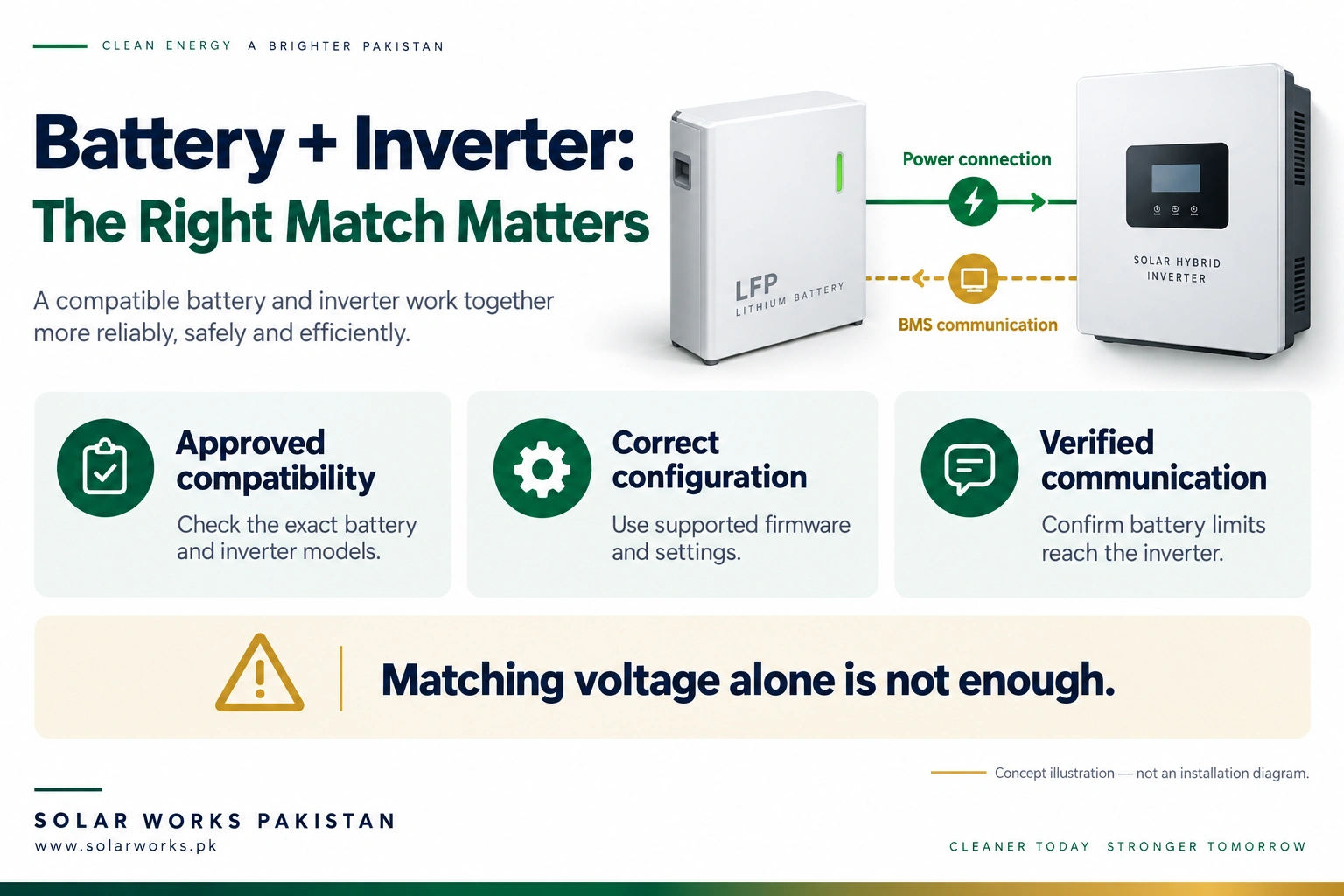
In a hybrid solar system the battery and the inverter work as a pair. The inverter decides when to charge and discharge; the battery's BMS reports what it can safely accept and deliver. For that exchange to work, the two products have to be a supported combination — not simply two products with the same nominal voltage.

Matching voltage does not establish compatibility. Compatibility is what the manufacturers say they support: the exact models, the firmware versions, the charging and discharging limits, how many battery units may be connected, and the communication protocol between them. Three things have to line up.

Infographic: battery plus inverter, the right match matters - approved compatibility, correct configuration and verified communication, with a warning that matching voltage alone is not enough
A concept illustration of the power and communication links between a battery and a hybrid inverter — not an installation diagram. View full infographic ↗
One

Approved compatibility

Both manufacturers should support the exact battery model with the exact inverter model — usually published as a compatibility list, with conditions attached such as firmware versions and the number of battery units allowed.

Two

Correct configuration

The inverter has to be set up for the battery that is actually installed: the right battery selection in its settings, supported firmware, and the manufacturer-specified operating limits and modes — then verified by the installer.

Three

Verified communication

The BMS and the inverter have to be genuinely exchanging data — battery status, operating limits and alarms. A cable plugged into a port does not prove that the link is working; it has to be confirmed at commissioning.

Why Professional Installation Matters

Everything above is decided in a factory or a manual. Installation is where it becomes real, and it is the part of the job you can judge before you commit.

Comparison infographic: a professional battery installation with tidy conduit and protection beside a poor installation with exposed connections and blocked clearances
The same equipment, two standards of work. View full infographic ↗

What good work looks like

Secure mounting on a surface that can carry the weight, so the battery cannot shift or fall. Correctly sized cables for the current the system can draw, with terminations made to the specified torque. Protected terminals and covered connections, so nothing live is exposed. Manufacturer-required clearances around the enclosure, so heat can escape and the unit stays serviceable. Suitable circuit protection and isolation on both the battery and inverter sides, sized and rated for the equipment installed.

What unqualified work costs

When those basics are skipped the consequences are usually mundane before they are serious: nuisance shutdowns, an inverter that will not charge the battery properly, capacity that never matches the specification. Undersized cables and loose terminations run hot. Missing isolation makes safe maintenance difficult. Blocked clearances trap heat, which shortens battery life and can push the BMS into protective shutdowns.

None of this is an argument about any particular company. It is simply why the work should be done by installers who follow the manufacturer's requirements, test what they have built, and hand over documentation that shows it.

Before You Buy

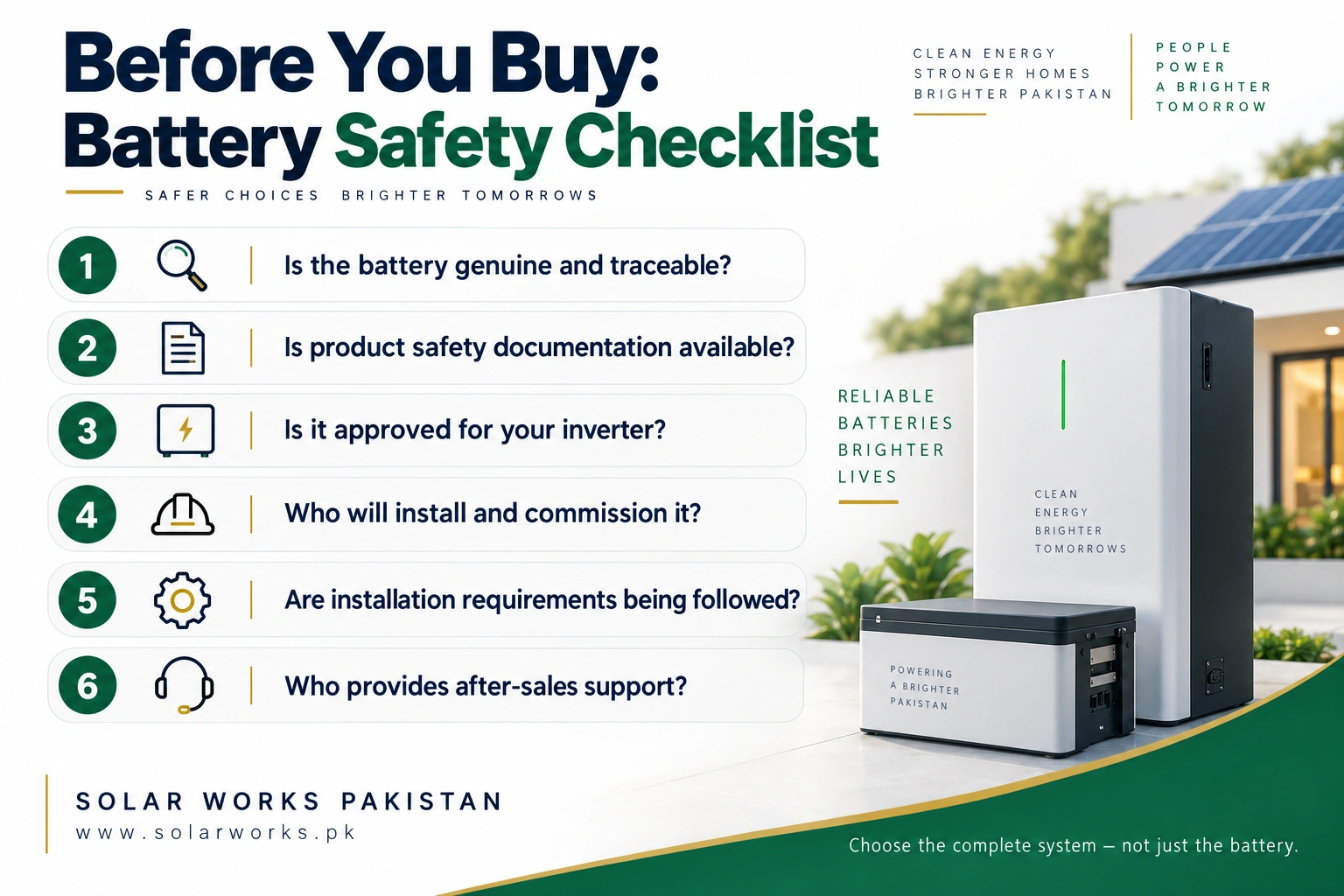
Six questions settle most of what matters before money changes hands. If a supplier cannot answer them clearly, that is useful information in itself.

Infographic checklist to run before buying a solar battery: genuine and traceable product, safety documentation, inverter approval, who installs and commissions it, installation requirements and after-sales support
Six checks to run before you buy — choose the complete system, not just the battery. View full infographic ↗

Take the answers together rather than one at a time. A genuine battery with documentation, approved for your inverter, installed and commissioned by people who will still answer the phone in three years, is a different purchase from a cheaper unit that satisfies only one of those conditions.